How this tool works
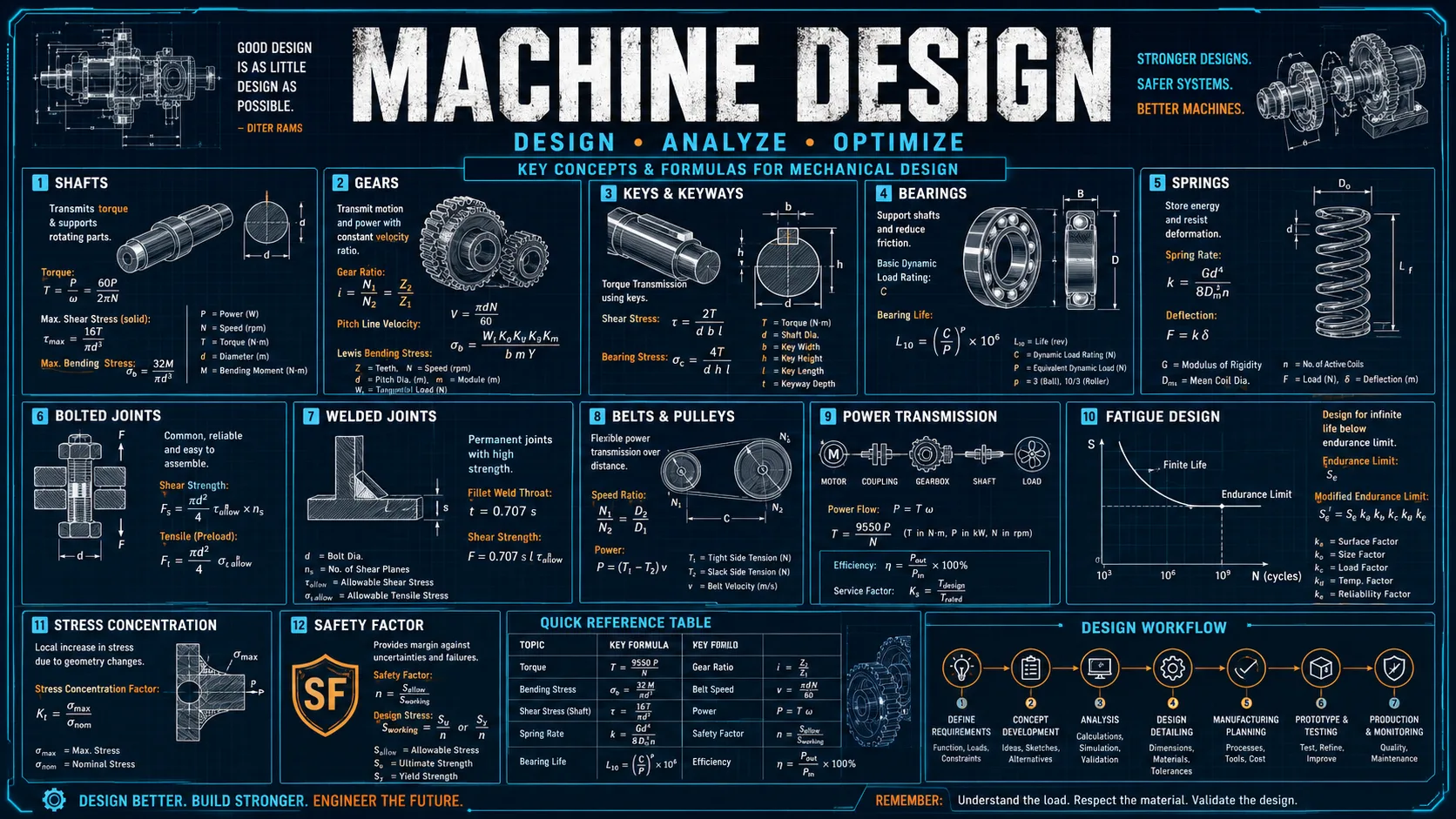
Model common geared transmissions and compare how tooth counts affect output speed, direction, torque multiplication, and pitch-line velocity.
Switch between single external meshes, multi-stage compound trains, internal ring-and-pinion meshes, and planetary gearsets with selectable input and fixed members.
Animated diagrams help connect the kinematic relationships to the geometry actually transmitting the motion.
Method and assumptions
For ordinary and internal meshes, calculate the tooth-count ratio and infer output speed from equal pitch-line velocity.
For compound trains, multiply stage ratios and propagate speed/torque stage-by-stage.
For planetary trains, use the Willis relationship between sun, ring, and carrier speeds after selecting the fixed and input members.
Render a schematic animation whose rotation rate is proportional to the calculated speeds.
Assumptions
- The simulator uses rigid gears with ideal involute-like pitch relationships and does not model tooth deflection, backlash, or impact.
- Efficiency is represented by a simple scalar entered by the user. Losses are not load, speed, temperature, lubrication, or duty dependent.
- The simple planetary mode assumes a concentric single-stage sun-planet-ring set and uses the classic Willis relationship for kinematics.